.jpg)
$1.40 Face Ounce‑Class — 2 Halves + 4 Dimes (6‑Coin Build)
$1.40 Face Ounce‑Class — 2 Halves + 4 Dimes (6‑Coin Build)
Slide description (fun + deep-dive, with weights)
A clean, “showpiece” constitutional ounce: two half dollars as the anchors and four dimes as the change‑makers. This build is popular because it looks balanced in a slab, stacks like a bar, and still breaks down into practical fractions if you ever need to trade smaller pieces.
Face value math: 2 × $0.50 = $1.00, plus 4 × $0.10 = $0.40 → $1.40 face total.
Silver math (Mint spec, 90% U.S. coinage):
Half dollar: 12.50 g coin weight × 90% = 11.25 g silver ≈ 0.3617 troy oz ASW each
Dime: 2.50 g coin weight × 90% = 2.25 g silver ≈ 0.0723 troy oz ASW each
Total ASW: (2 × 0.3617) + (4 × 0.0723) ≈ 1.0127 troy oz of pure silver — that’s why $1.40 is considered “one‑ounce‑class.” In typical circulated condition, wear can pull that number closer to ~1.00 oz, which is exactly why stackers love this standard.
Coins that can be used in this exact build
Use 90% silver only (generally pre‑1965):
Half dollars (90%): Barber, Walking Liberty, Franklin, Kennedy 1964
Dimes (90%): Barber, Mercury, Roosevelt 1946–1964
Note: Actual silver weight varies with wear and year/type—best practice is to verify with a scale if you’re targeting a tight “ounce‑class” spec.
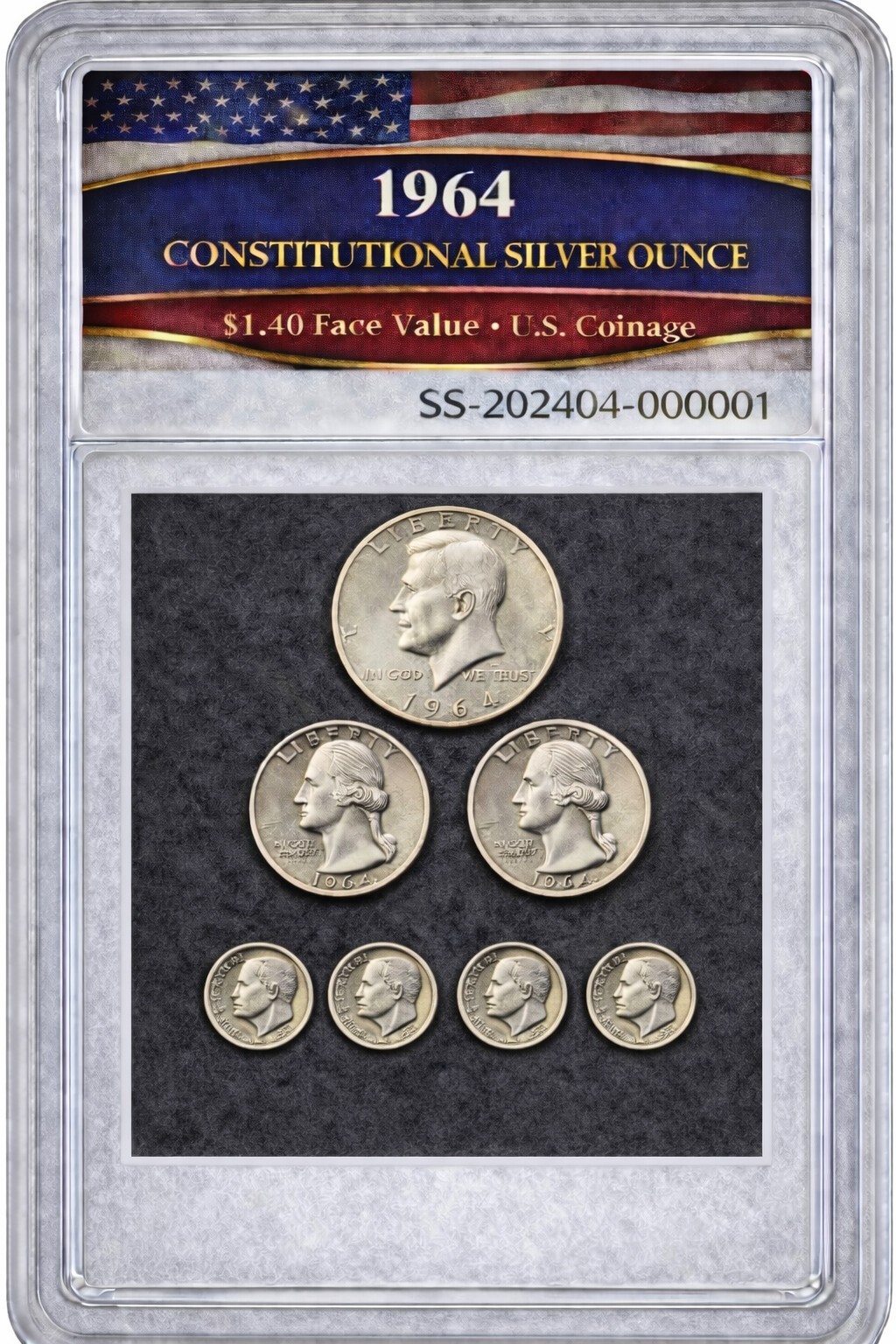
$1.40 Face Ounce‑Class — 1 Half + 2 Quarters + 4 Dimes (7‑Coin Build)
This is the “three‑denomination” constitutional ounce: a Kennedy half on top, two quarters as the mid‑tier, and four dimes as the precision change. It’s one of the best storytelling layouts because it looks like a miniature slice of real U.S. money—three everyday denominations, unified into a single ounce‑class unit you can stack, display, or break down if needed.
Face value math: $0.50 + (2 × $0.25 = $0.50) + (4 × $0.10 = $0.40) → $1.40 face total.
Silver math (Mint spec, 90% U.S. coinage):
Half dollar: 12.50 g coin weight × 90% = 11.25 g silver ≈ 0.3617 troy oz ASW
Quarter: 6.25 g coin weight × 90% = 5.625 g silver ≈ 0.1808 troy oz ASW each
Dime: 2.50 g coin weight × 90% = 2.25 g silver ≈ 0.0723 troy oz ASW each
Total ASW: 0.3617 + (2 × 0.1808) + (4 × 0.0723) ≈ 1.0127 troy oz of pure silver (mint spec). That’s why $1.40 is considered “one‑ounce‑class.” In typical circulated condition, wear can pull the effective silver content closer to ~1.00 oz, which is exactly why stackers love this standard.
Why this build is so practical: if you ever crack the unit, you can “make change” in 50¢, 25¢, and 10¢ steps—fast for real‑world trading, and familiar to anyone who has ever handled cash. It’s ounce‑class silver that still behaves like money.
Coins that can be used in this exact build
Use 90% silver only (generally pre‑1965):
Half dollars (90%): Barber, Walking Liberty, Franklin, Kennedy 1964
Quarters (90%): Barber, Standing Liberty, Washington (pre‑1965)
Dimes (90%): Barber, Mercury, Roosevelt 1946–1964
Note: Avoid 40% half dollars (1965–1970) for this format. Actual silver weight varies with wear and year/type—best practice is to verify with a scale if you’re targeting a tight “ounce‑class” spec.
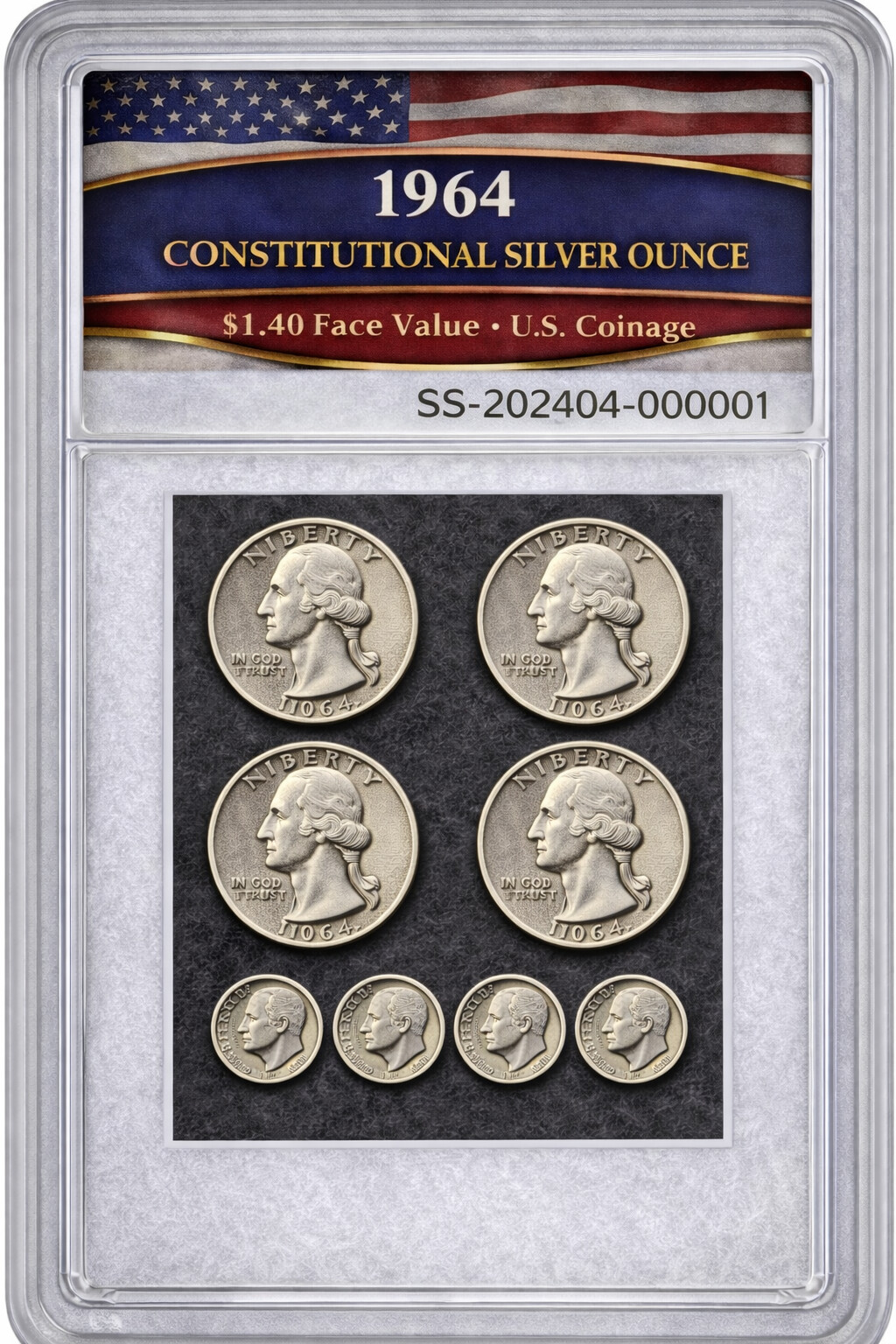
$1.40 Face Ounce‑Class — 4 Quarters + 4 Dimes (8‑Coin Build)
This is the “perfect symmetry” constitutional ounce: four Washington quarters in a clean 2×2 block, framed by four dimes as accent pieces. It’s one of the most satisfying slabs to look at because it reads instantly as a single, organized unit—no randomness, no clutter—just real U.S. money arranged like a collectible.
Face value math: (4 × $0.25 = $1.00) + (4 × $0.10 = $0.40) → $1.40 face total.
Silver math (Mint spec, 90% U.S. coinage):
Quarter: 6.25 g coin weight × 90% = 5.625 g silver ≈ 0.1808 troy oz ASW each
Dime: 2.50 g coin weight × 90% = 2.25 g silver ≈ 0.0723 troy oz ASW each
Total ASW: (4 × 0.1808) + (4 × 0.0723) ≈ 1.0127 troy oz of pure silver (mint spec). That’s why $1.40 is considered “one‑ounce‑class.” In typical circulated condition, wear can pull the effective silver content closer to ~1.00 oz—exactly why stackers love the $1.40 standard for real-world, repeatable units.
Why this build is so practical: if you ever break the unit, you can trade in familiar 25¢ and 10¢ steps. It’s ounce‑class silver that still behaves like spendable change—clean increments, easy counting, and high liquidity.
Coins that can be used in this exact build
Use 90% silver only (generally pre‑1965):
Quarters (90%): Barber, Standing Liberty, Washington (pre‑1965)
Dimes (90%): Barber, Mercury, Roosevelt 1946–1964
Collector note: A same‑year set like “1964 (Philadelphia / no mint mark)” is especially fun because 1964 is the final year of 90% silver dimes and quarters—an end‑of‑era ounce that still stacks like a modern unit.
Note: Actual silver weight varies with wear and year/type—best practice is to verify with a scale if you’re targeting a tight “ounce‑class” spec.
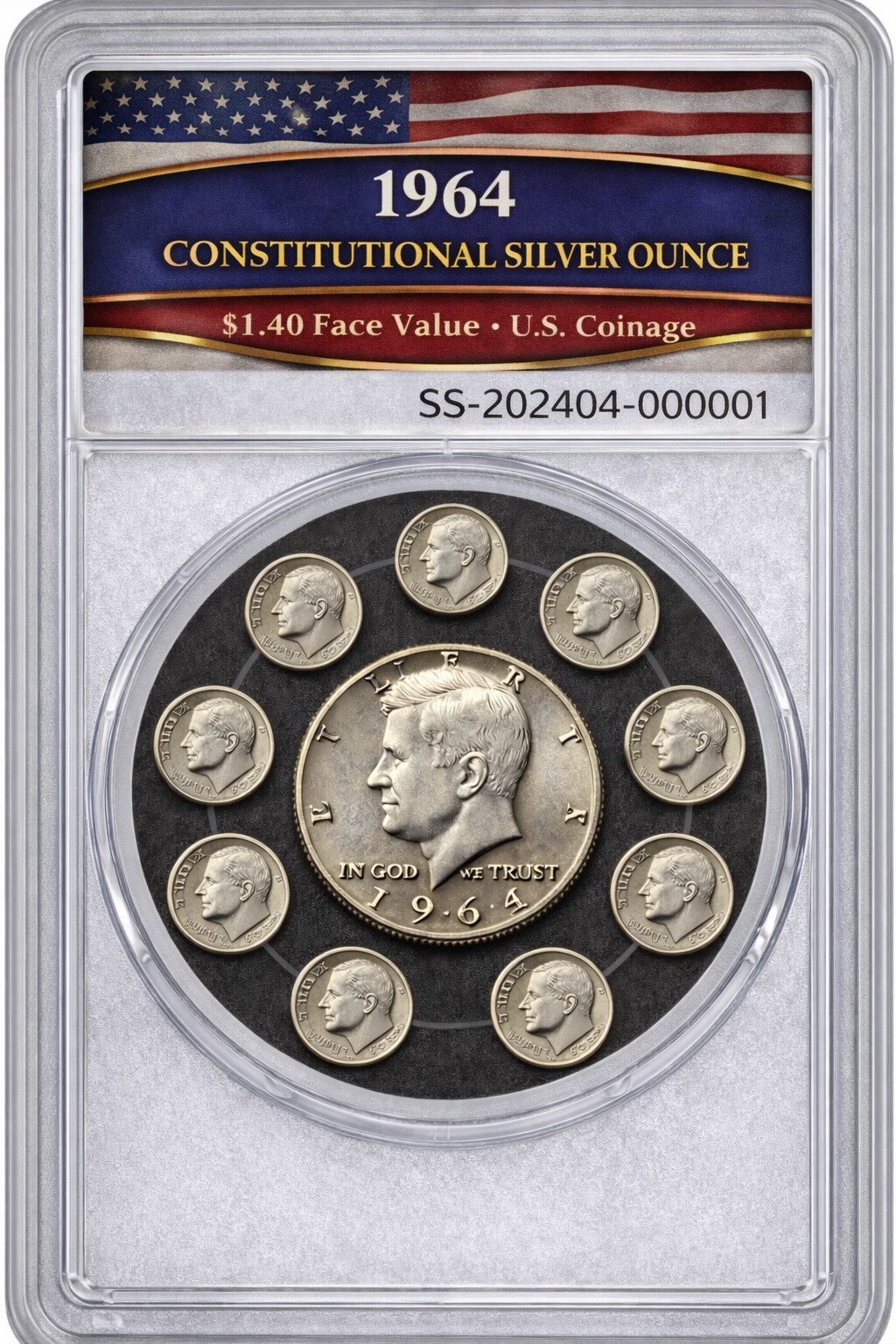
$1.40 Face Ounce‑Class — 1 Half + 9 Dimes (10‑Coin Build)
This is the “change‑master” constitutional ounce: one bold half dollar as the centerpiece, surrounded by nine dimes that act like built‑in fractional change. It’s a favorite because it trades like a single unit, but it still lets you “make change” in dime steps without breaking the whole concept.
Face value math: $0.50 + (9 × $0.10 = $0.90) → $1.40 face total.
Silver math (Mint spec, 90% U.S. coinage):
Half dollar: 12.50 g coin weight × 90% = 11.25 g silver ≈ 0.3617 troy oz ASW
Dime: 2.50 g coin weight × 90% = 2.25 g silver ≈ 0.0723 troy oz ASW each
Total ASW: 0.3617 + (9 × 0.0723) ≈ 1.0127 troy oz of pure silver (mint spec). That’s why $1.40 is considered “one‑ounce‑class.” In real circulated condition, wear often nudges the effective silver content closer to ~1.00 oz, which is exactly why this standard became so popular with stackers.
Why this specific example is extra collectible: 1964 was the last year of 90% silver dimes (and the Kennedy half is 90% only in 1964). A same‑year set like “1964 (Philadelphia / no mint mark)” feels like a true micro‑set, not a random handful.
Coins that can be used in this exact build
Use 90% silver only (generally pre‑1965):
Half dollars (90%): Barber, Walking Liberty, Franklin, Kennedy 1964
Dimes (90%): Barber, Mercury, Roosevelt 1946–1964
Note: Avoid 40% half dollars (1965–1970) for this format. Actual silver weight varies with wear and year/type—best practice is to verify with a scale if you’re targeting a tight “ounce‑class” spec.
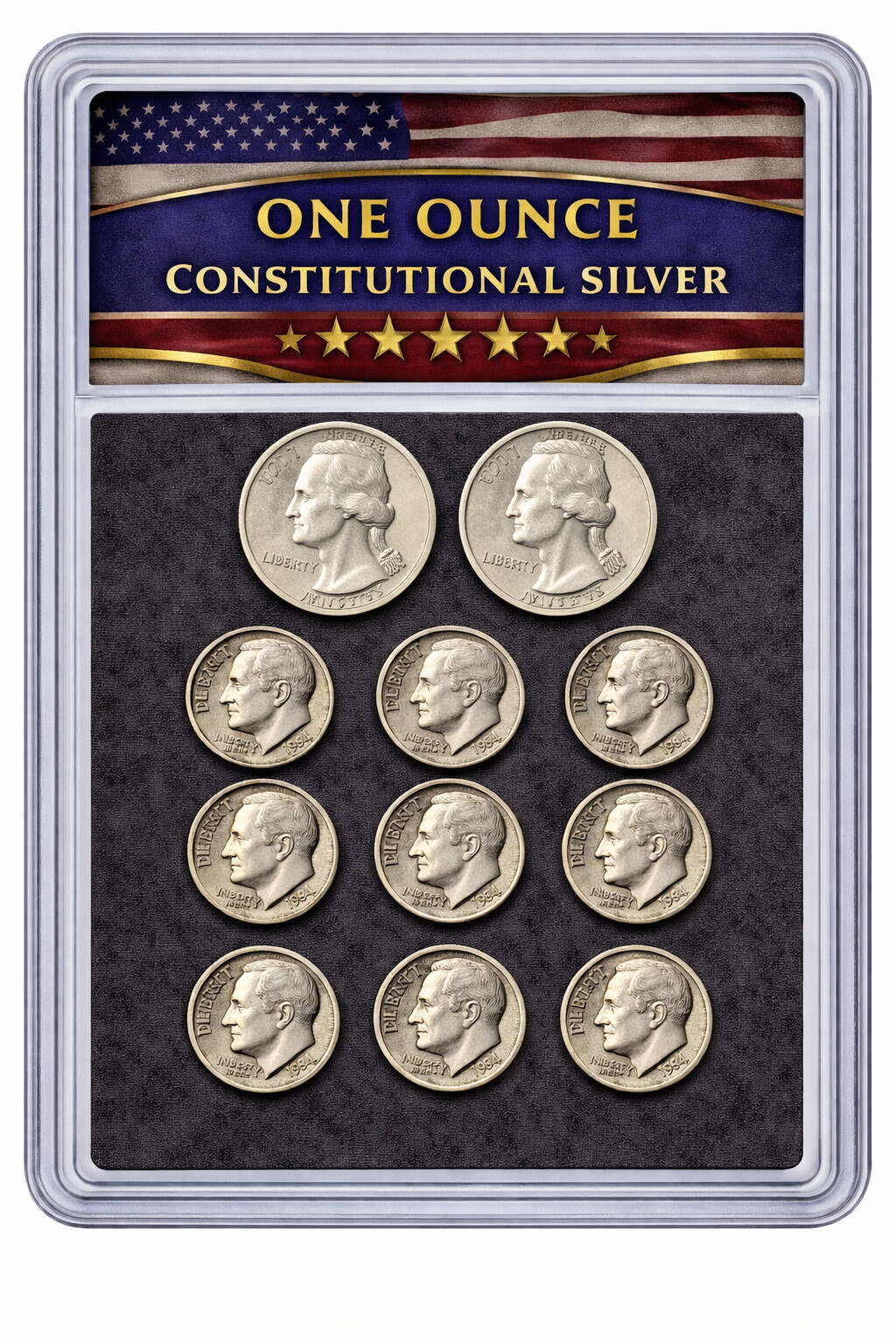
$1.40 Face Ounce‑Class — 2 Quarters + 9 Dimes (11‑Coin Build)
This layout is the “quarter‑crown grid”: two Washington quarters up top, then a clean 3×3 matrix of nine dimes beneath. It’s visually satisfying, easy to count at a glance, and it avoids half dollars entirely—great for builders who want ounce‑class consistency without chasing halves.
Face value math: (2 × $0.25 = $0.50) + (9 × $0.10 = $0.90) → $1.40 face total.
Silver math (Mint spec, 90% U.S. coinage):
Quarter: 6.25 g coin weight × 90% = 5.625 g silver ≈ 0.1808 troy oz ASW each
Dime: 2.50 g coin weight × 90% = 2.25 g silver ≈ 0.0723 troy oz ASW each
Total ASW: (2 × 0.1808) + (9 × 0.0723) ≈ 1.0127 troy oz of pure silver (mint spec). That’s why $1.40 is considered “one‑ounce‑class.” In real circulated condition, normal wear can pull the effective silver content closer to ~1.00 oz, which is exactly why the $1.40 standard became so widely used for practical stacking.
Why stackers like this build: you get two “medium” denominations for faster mental math, plus nine dimes for granular flexibility. If you ever break the unit, you can make change in both 25¢ and 10¢ steps—clean, familiar, and highly liquid.
Coins that can be used in this exact build
Use 90% silver only (generally pre‑1965):
Quarters (90%): Barber, Standing Liberty, Washington (pre‑1965)
Dimes (90%): Barber, Mercury, Roosevelt 1946–1964
Note: Actual silver weight varies with wear and year/type—best practice is to verify with a scale if you’re targeting a tight “ounce‑class” spec.
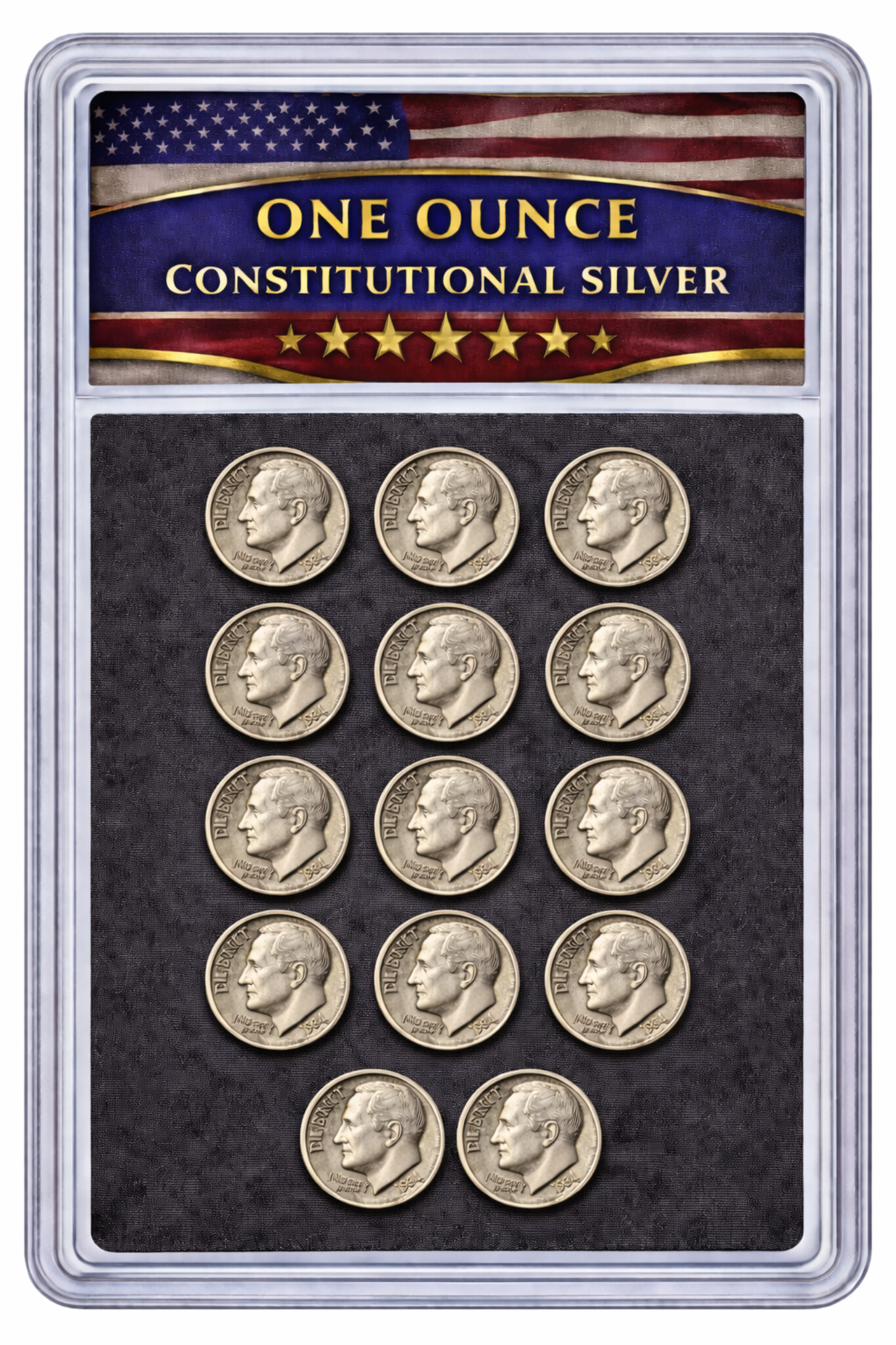
$1.40 Face Ounce‑Class — 14 Dimes (14‑Coin “Dime‑Only” Build)
This is the “pure change” constitutional ounce: fourteen 90% silver dimes, laid out in a clean grid that looks like a mini mint sheet. No halves. No quarters. Just maximum flexibility. If you ever need to break the unit, you can make change in the smallest constitutional step (10¢) while still keeping everything inside a single ounce‑class standard.
Face value math: 14 × $0.10 = $1.40 face total.
Silver math (Mint spec, 90% U.S. coinage):
Dime: 2.50 g coin weight × 90% = 2.25 g silver ≈ 0.0723 troy oz ASW each
Total ASW: 14 × 0.0723 ≈ 1.0127 troy oz of pure silver (mint spec). That’s why $1.40 is considered “one‑ounce‑class.” In typical circulated condition, wear can pull the effective silver content closer to ~1.00 oz—exactly why stackers love this unit definition for repeatability.
Why this build is so practical:
1) It’s extremely liquid (dimes are among the easiest 90% coins to buy/sell).
2) It’s the easiest to “make change” with—ten-cent increments are intuitive in real trades.
3) It’s manufacturing-friendly: uniform coin size makes clean layouts, consistent spacing, and fast verification.
4) It’s the ultimate “micro‑mint” unit: one denomination, one spec, one repeatable standard.
Coins that can be used in this exact build
Use 90% silver dimes only (generally pre‑1965):
Dimes (90%): Barber, Mercury, Roosevelt 1946–1964
Collector note: The dime‑only build is ideal for same‑year and same‑mint projects because you’re sourcing one coin type. Complete a full 14‑dime set from a single year/mint and it feels like a true “batch” unit.
Note: Actual silver weight varies with wear and year/type—best practice is to verify with a scale if you’re targeting a tight “ounce‑class” spec.